Illinois +8.5 vs. Oregon | Model Edge and Situation point to Illini
Model Edge, Situation, and Oregon's QB problem favor Illinois
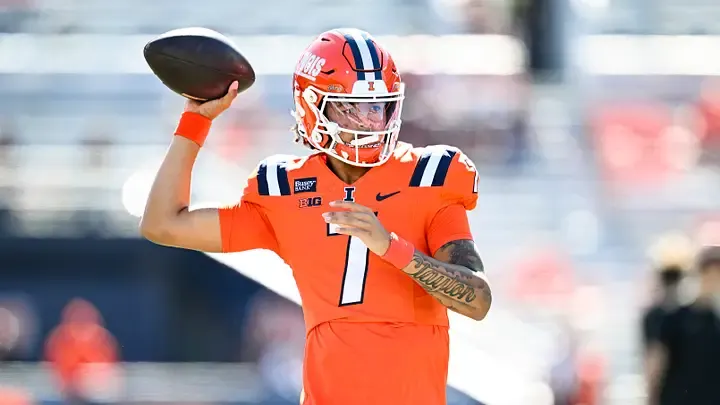
Risk: 1 Unit
The Handicap
Illinois catches +8.5 at home against Oregon in a matchup where we think the market may be giving too much weight to Oregon's full-season profile and not enough weight to the uncertainty surrounding its current offense.
There are three pieces to the handicap:
- Our model makes Illinois meaningfully more competitive than the market.
- Illinois qualifies for our Off-Bye Home Dog system.
- Oregon's quarterback change creates legitimate uncertainty around how representative its season-long offensive rating is.
Importantly, Illinois has also made a quarterback change. But the limited evidence we have so far does not justify automatically downgrading Illinois for that change.
Model Edge
Market: Illinois +8.5
Model: Illinois +3.4
Our opponent-adjusted model makes this game materially tighter than the market, and Oregon's results against legitimate competition provide additional support for that discrepancy.
Oregon enters this matchup just 1-4 ATS against FBS opponents this season. ATS records alone aren't predictive enough to drive a wager, but in this case the record helps illustrate a recurring theme: the market has consistently priced Oregon more aggressively than its actual margins have justified.
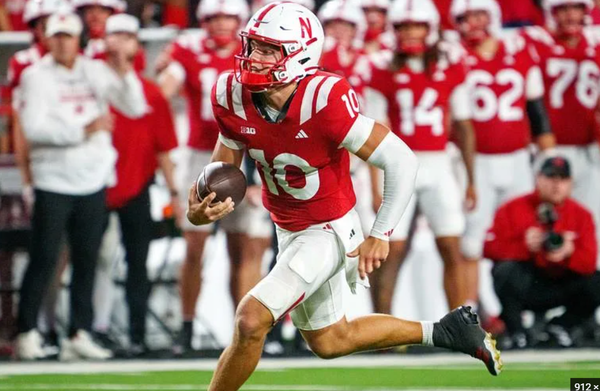
That was evident again last week against Nebraska. Oregon escaped 17-14 at home as roughly a touchdown favorite, despite being held to 242 total yards and 3.2 yards per play. The Ducks went just 3-for-17 on third down, committed two turnovers and didn't score their only touchdown until the final 28 seconds.
The passing performance was particularly notable. Oregon managed only 113 passing yards on 38 attempts, or roughly 3.0 yards per attempt. Nebraska actually finished with the better overall yards-per-play figure.
Off-Bye Home Dog
Illinois also qualifies for one of our established situational systems:
Home underdog coming off a bye while its opponent played the previous week.
Historically, this situation has produced:
83-64-6 ATS — 56.5%
Illinois had Week 7 off, while Oregon played Nebraska.
The bye is particularly relevant here because Illinois enters this game amid a quarterback transition. The additional preparation period gives the offense an opportunity to build a game plan around its new quarterback rather than making that adjustment in the middle of a game.
The Oregon Quarterback Question
The biggest reason we're hesitant to treat Oregon's season-long offensive rating at face value is its quarterback change from Dante Moore to Dylan Raiola.
Using play-by-play data through Week 7, Moore was the more efficient quarterback on a raw EPA basis:
| Oregon QB | Pass Plays | Raw EPA/Play |
|---|---|---|
| Dante Moore | 109 | +0.237 |
| Dylan Raiola | 80 | +0.154 |
| Difference | -0.083 |
At first glance, that's a meaningful decline.
However, we don't want to overstate it. Once opponent quality is incorporated, the evidence becomes much less conclusive. Raiola's opponent-adjusted production has actually held up well.
The bigger concern is volatility.
Raiola's opponent-adjusted performances have swung dramatically from game to game. His strongest performance was excellent, while his worst was extremely poor.
That should increase the uncertainty around Oregon's offensive projection.
For a favorite being asked to win by more than a touchdown on the road, that uncertainty matters.
Why Illinois' QB Change Is Different
Illinois presents the opposite problem.
Illinois changed quarterbacks after an interception against Michigan State, turning to Michael Clayton II.
Clayton's sample is extremely small, so we shouldn't pretend eight passes establish his true talent level. MC2 did pass the eye test for me.
But what happened after the change is still informative:
| Michael Clayton II after entering | Result |
|---|---|
| Completions / Attempts | 6 / 8 |
| Passing Yards | 88 |
| Yards / Attempt | 11.0 |
| TD / INT | 2 / 0 |
| EPA / Pass Play | +1.22 |
Illinois' passing offense did not collapse when Clayton entered.
In fact, he immediately generated explosive passing production, including completions of 14, 24, 14 and 25 yards, with two touchdowns.
We are absolutely not projecting Clayton to maintain +1.22 EPA/play. Eight attempts tell us very little about his true ability.
But that's exactly the point.
There currently isn't evidence supporting a meaningful downward adjustment to Illinois' offensive rating simply because it changed quarterbacks.
Why Illinois +8.5
The case isn't dependent on any single indicator.
Our model already prefers Illinois at the market number. Illinois then gets an established Off-Bye Home Dog situational fit, while Oregon carries additional offensive uncertainty because its season-long rating blends production from two different quarterbacks.
Meanwhile, Illinois' own quarterback change hasn't yet produced evidence that warrants lowering its offensive expectation. Clayton was highly productive in his limited action, and Illinois had the bye week to prepare him for a larger role.
We're not projecting Illinois' new quarterback to be a star, nor are we declaring Raiola a downgrade.
We're taking advantage of the asymmetry in uncertainty.
At +8.5 at home, Illinois doesn't need to prove it is the better team. It needs to keep a game our model already sees as competitive within more than a touchdown.
Pick: Illinois +8.5
Risk: 1 Unit